

You do not need jumping, heavy barbells, or a gym floor to get stronger at home. After 50, the goal is simple. Keep muscle, keep balance, and keep joints happy. Low-impact strength training does that with slow, controlled moves and light gear.
This is a starter plan for home. No floor work. No jumping. Every move can be done standing or with a bench or sturdy chair for support. Start light. Add a little only when the last two reps still feel clean.
Key Takeaways
- Train 2 days per week to start. One 20-minute session is enough. Rest at least one day between sessions.
- Use support on purpose. A bench or sturdy chair for sit-to-stands and balance work is good form, not a shortcut.
- A full starter kit can cost under $100. One light band, one heavier band, a light pair of dumbbells, and a foam roller cover this whole plan.
The Workout: 20 Minutes, 5 Moves
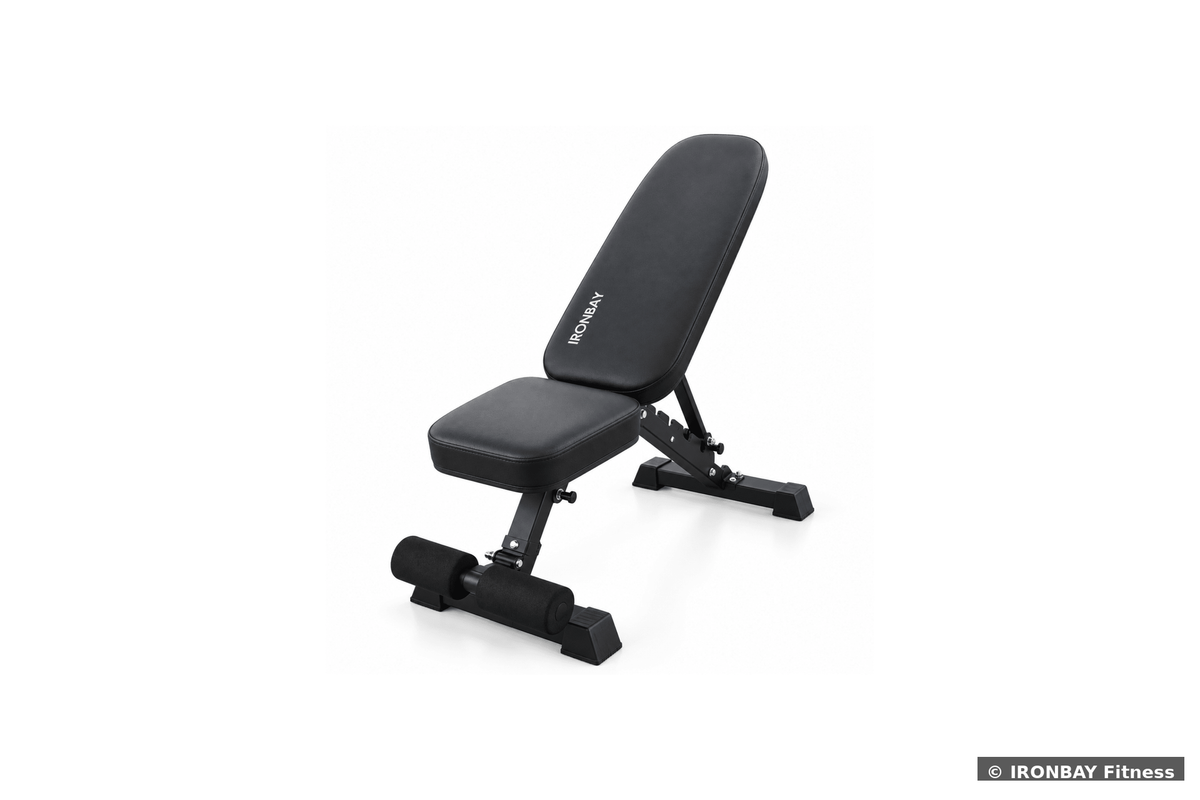
- Supported sit-to-stand, 3 sets of 8 reps. Sit on the edge of a bench. Feet flat, hip width apart. Lean forward a little from the hips, push through your whole foot, and stand tall. Sit back down slow. Rest 60 seconds between sets. Keep a hand on the bench if you need balance help.
- Band row, 3 sets of 10 reps. Stand on the middle of a long loop band. Hold one side in each hand. Hinge forward a little with a flat back. Pull your elbows back past your ribs, squeeze for one second, then lower slow. This trains back and posture with no weight on the floor.
- Light dumbbell press, 3 sets of 8 reps. Sit tall on the bench or stand with feet wide. Hold one light dumbbell in each hand at shoulder height. Press up until arms are straight but elbows are not locked hard. Lower slow for 3 seconds.
- Light kettlebell hinge, 3 sets of 8 reps. Stand with a light kettlebell between your feet. Push your hips back, keep your back flat, grab the handle, and stand up by pushing the floor away. The bell stays close to your body. Stop well before your form breaks down.
- Supported calf raise and balance, 2 sets of 10 reps. Stand behind the bench and hold it light for balance. Rise up on both feet, pause one second at the top, lower slow. When this feels steady, hold the top for 10 seconds on the last rep of each set.
Cool down for 2 minutes. Walk around the room, breathe slow, then roll calves and upper back on a foam roller if that feels good. Stop any move that causes sharp pain.

© IRONBAY Fitness. Images not for commercial use.
What Weight Should You Start With?
Start lighter than you think. For bands, most starters do well with the Yellow 5 to 15 lb band first, then the Red 15 to 30 lb band when 10 clean reps feel easy. For dumbbells, a 5 lb or 10 lb single is a common starting point for presses. For the hinge, a 5 lb or 10 lb kettlebell is enough to learn the pattern. These are starting points only. Your right weight is the one that lets you finish every rep with clean form and no sharp pain.
Move up in small steps. Finish all sets with good form two sessions in a row before you go heavier. Small jumps protect joints and keep you training week after week.
What You Need
Bands first. IRONBAY resistance bands are long loop bands, 2080 mm in full length. Yellow 5 to 15 lb is $10. Red 15 to 30 lb is $13. The full 5-band set is $70 if you want every level in one kit.
Light dumbbells. IRONBAY hex dumbbells cost $0.88/lb. A 5 lb single is $4.40 and a 10 lb single is $8.80, so a light pair costs $8.80 to $17.60. Hex heads do not roll on the floor.
One light kettlebell. IRONBAY kettlebells are solid cast iron with a Lifetime Personal Warranty. The 5 lb bell is $8 and the 10 lb bell is $16.
Support and floor. The IRONBAY N02 adjustable bench is $99 and gives you a firm seat for sit-to-stands and seated presses. One 38 by 38 inch gym mat is $45 and gives bands and feet a grippy, cushioned base. A foam roller, 17.7 by 4.7 inches, is $18 for the cool-down.
A simple starter kit adds up clean. Yellow band $10 plus Red band $13 plus a pair of 5 lb hex dumbbells $8.80 plus a foam roller $18 plus one 38 inch mat $45 equals $94.80. Add the bench later if you want firmer support than a chair.
Shop online now.
FAQ
Is strength training safe after 50 if I have sore knees?
Low-impact moves with support are a common starting point, but knees are personal. Use a higher seat, a smaller range, and lighter weight first. If you have a joint condition, an injury, or new pain, check with your doctor or physio before you start.
How often should a beginner train each week?
Two days per week is a strong start. Keep at least one rest day between sessions. After 3 to 4 steady weeks, you can add a third short day if recovery feels good.
Do I need to get on the floor?
No. Every move in this plan is standing or seated on a bench. That is the point. You can train legs, back, arms, and balance without floor work.
When should I go heavier?
When you finish every set with clean form two sessions in a row and the last two reps feel controlled, not hard. Move up one small step at a time, for example from the Yellow band to the Red band.
Updated November 7, 2026. New to training, coming back after a break, or training with a medical condition? Check with your doctor, coach, or physio before you start.


