

A resistance band weighs almost nothing. It folds into a drawer, a suitcase, or a desk. And it can load almost every muscle you own.
That is the whole point of loop resistance bands in a home gym. No rack. No plates. No floor space given up for good. You anchor the band, stand on it, or loop it over a bar, and you train. This guide covers where bands work best, one full session you can run anywhere, and how to pick the right band the first time.
Key Takeaways
- One loop band covers warm ups, full workouts, travel training, and light work when you are coming back. Two bands cover almost everything else.
- Tension is not fixed. Step back, grip the band shorter, or slow the rep down, and the same band gets harder.
- The full loop is 2080 mm, about 82 inches around, and 1040 mm laid flat, about 41 inches. Long enough for deadlifts, presses, and assisted pull ups.
Where Resistance Bands Work Best
Small rooms and corners. A band workout needs about as much floor as a yoga mat. Rows, presses, and squats all happen standing in one spot. When you finish, the whole gym goes back in a drawer.
Travel and hotel rooms. Bands roll up and fit in a carry on. No weights to check, nothing to drop on a hotel floor. The same session you run at home runs the same way on the road.
Office and desk breaks. Keep the light band in a desk drawer. Two sets of rows and pull aparts between calls undo an hour of chair posture in about three minutes.
Warm up and activation. Before barbell work, five minutes with a light band wakes up the muscles that protect your shoulders and hips: pull aparts, face pulls, and glute work. Cheap insurance for heavy days.
Light work when you are coming back. After time off, bands let you train with low load and full control. Short range, slow reps, stop well before failure. If something gives you sharp pain, stop. If you are rehabbing an injury, follow your physio's plan, not a blog post.
Adding resistance to barbell lifts. Loop a band over each end of the bar and anchor it low on the rack. The lift gets heavier toward the top, where you are strongest. Banded deadlifts and squats are a staple in serious home gyms for a reason.
The Workout: Full Body in 25 Minutes
Run the moves in order. Rest 45 to 60 seconds between sets. Pick a band that makes the last 2 reps of each set slow and hard, with clean form.
- Band deadlift: 3 sets of 12 reps. Black or Purple.
- Standing chest press: 3 sets of 12 reps. Red or Black.
- One arm row: 3 sets of 10 reps per side. Black.
- Band squat: 3 sets of 12 reps. Black or Purple.
- Lateral raise: 3 sets of 12 reps. Yellow or Red.
- Pallof press: 2 sets of 10 reps per side. Yellow or Red.
- Pull apart finisher: 2 sets of 15 reps. Yellow or Red.
How to Do Each Move
Band deadlift. Stand on the middle of the band, feet hip width apart. Grip the loop on each side of your feet. Hinge at the hips with a flat back, push the floor away, and stand tall. Squeeze your glutes at the top. Lower with control.
Standing chest press. Loop the band behind your upper back, under your armpits. Hold one side in each hand at chest height. Press straight ahead until your arms are straight. Keep your ribs down. Step forward for more tension.
One arm row. Stand on the band with both feet and hinge forward, flat back, soft knees. Pull one end of the loop up to your hip, elbow close to your body. Lower slowly. Finish one side, then switch.
Band squat. Stand on the band, feet shoulder width apart. Bring the loop up and hold it at shoulder height, elbows bent, band in front of your chest. Sit down between your heels, knees tracking over your toes. Stand up and squeeze at the top.
Lateral raise. Stand on the middle of the band. Hold one side of the loop in each hand, down at your thighs. Raise both arms out to the sides, up to shoulder height. Lower slowly. No swinging.
Pallof press. Anchor the band at chest height to a solid, fixed point. Stand sideways to the anchor and hold the band at your chest with both hands. Press straight out and resist the twist. Keep your hips and shoulders square. Bring it back and repeat.
Pull apart. Hold the band in front of you at shoulder height, arms straight, hands about shoulder width apart on the loop. Pull the band apart until it touches your chest. Squeeze your shoulder blades together. Return slowly.
Band safety, 20 seconds. Check the band for nicks and tears before every session. Anchor only to solid, fixed points, and test the anchor with a light pull first. Keep your face out of the line of a stretched band. If a band looks damaged, retire it.

© IRONBAY Fitness. Images not for commercial use.
Which Band Should You Start With?
All five IRONBAY bands are the same full loop: 2080 mm around, about 82 inches, and 1040 mm laid flat, about 41 inches. Length can differ a little from band to band. What changes is thickness, and thickness is tension.
- Yellow, 5 to 15 lb, $10: warm ups, shoulder work, pull aparts, and light work when you are coming back.
- Red, 15 to 30 lb, $13: light presses, beginner rows, and activation work.
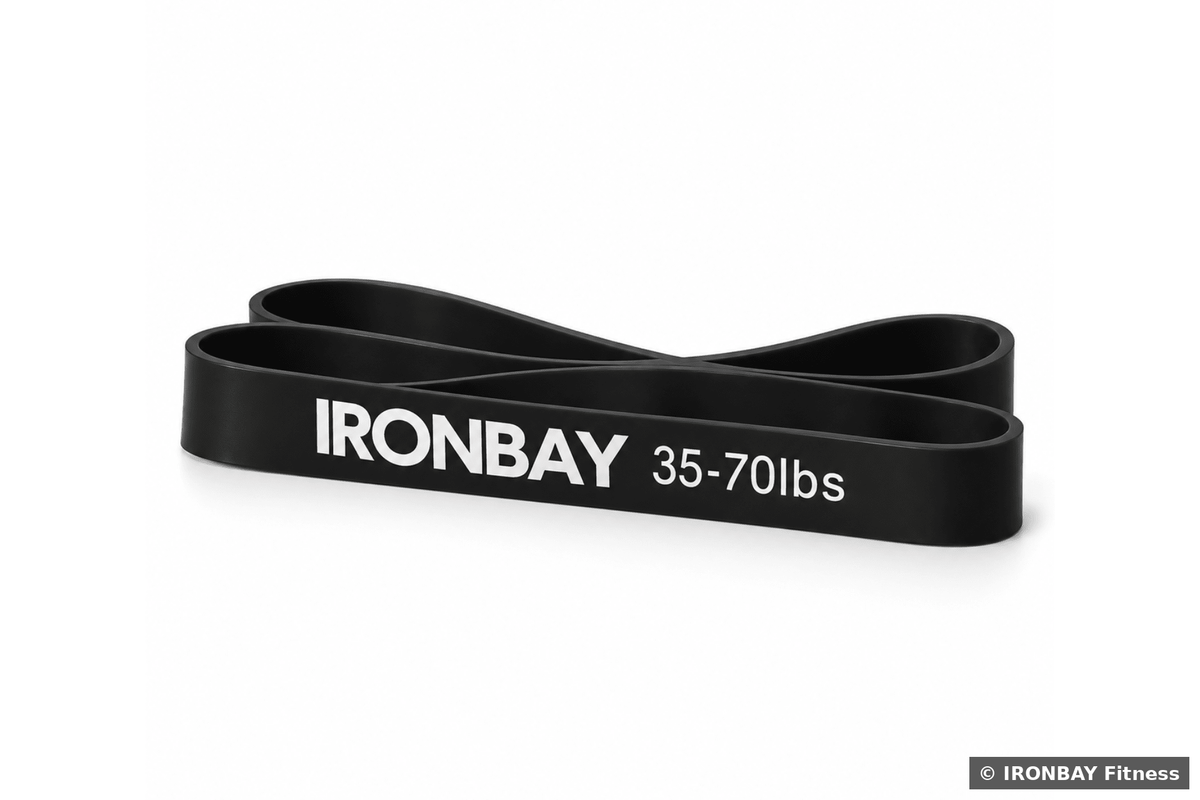
- Black, 35 to 70 lb, $16: the workhorse. Deadlifts, squats, rows, and presses for most people.
- Purple, 45 to 100 lb, $19: heavy lower body work, strong rows, and pull up assistance.
- Green, 50 to 120 lb, $22: the heaviest lifts, and the most help on pull ups.
- Full set of five, $70: every level covered, from warm up to heavy deadlift.
Start rule: if you buy one band, make it Black for lower body strength, or Red if you are new and training mostly upper body. When a band feels easy, step back, grip shorter, and slow the reps down before you buy the next colour up.
Shop IRONBAY Resistance Bands, from $10. Shop online now.
FAQ
How long are these resistance bands?
The full loop is 2080 mm, about 82 inches around. Laid flat, one side measures 1040 mm, about 41 inches, and each band can differ a little. That length works for deadlifts, standing presses, and assisted pull ups.
Can resistance bands replace dumbbells at home?
For a lot of training, yes. Bands load rows, presses, deadlifts, and squats with no rack and no plates. The feel is different: tension grows as the band stretches, so the top of the rep is the hardest part. Max effort barbell work still needs a bar. Bands cover the days, and the places, the bar cannot go.
Which band helps with pull ups?
The thicker the band, the more help it gives. Purple and Green give the most assistance. Loop the band over the bar, put one knee or one foot in the loop, and lower yourself with control. As you get stronger, move down one colour at a time.
How do I make a band exercise harder without a new band?
Step back from the anchor, grip the band shorter, slow the lowering phase down to 3 seconds, pause at the hardest point, or add reps. When all of that is easy, move up one colour.
Updated November 7, 2026. New to training or coming back from an injury? Check with a coach or physio before you start.


