

November in Calgary changes where you train. The garage gets cold, the driveway gets icy, and the basement starts to look like the best gym in town. The problem is that most basements are not ready. The floor is cold concrete, the air feels damp, and every dropped dumbbell sounds loud upstairs.
Here is a simple fix. Start with the floor, fix the damp and noise, then warm up longer than you did in summer. No big renovation, no new room, just a setup that works all winter.
Key Takeaways
- Cover the concrete first. Four 38 in x 38 in mats make a 76 in x 76 in training area for $180.00.
- Check for damp before you lay anything down. A dry floor keeps mats, gear, and feet in better shape.
- Warm up longer in a cold room: 3 minutes with a foam roller, then band work, then light sets before heavy sets.
- Crash pads cut noise and protect the floor when you train with a barbell in a shared house.
Step 1: Check the Floor Before You Buy Mats
Walk the basement in socks. Feel for cold spots, wet spots, and places where water has left a mark. If a corner is wet, do not cover it and hope it dries. Fix the water first, or at least keep gear off that spot until it stays dry.
Pick the flattest, driest corner with enough headroom to press overhead. Clear it completely. A clean rectangle trains better than a big messy room, and it makes mat math easy.
Step 2: Lay the Mats
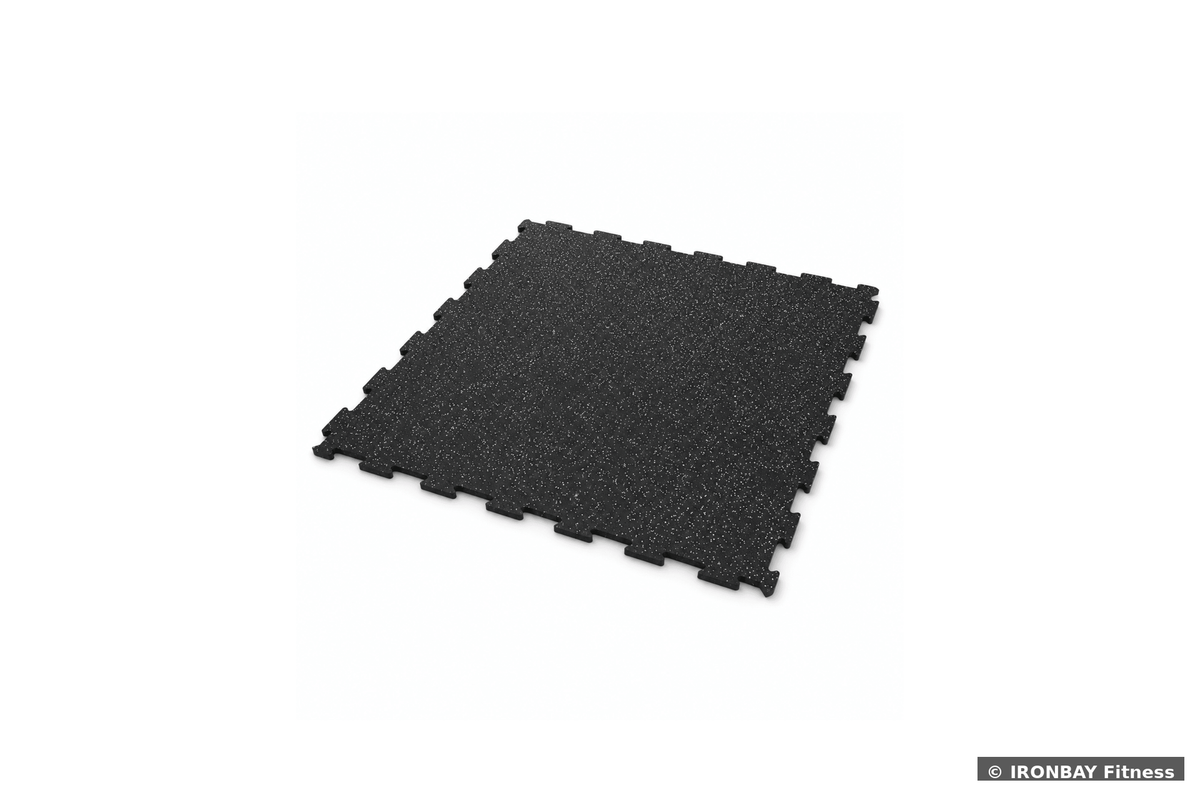
IRONBAY Gym Flooring Mats are interlocking rubber mats, 10 mm thick, with EPDM colour speckles. The edges lock together into one continuous surface, so the floor does not slide apart under your feet.
Start with four 38 in x 38 in mats at $45.00 each. Laid 2 by 2, they make about a 76 in x 76 in area. That covers a bench, a dumbbell pair, and room to squat. Four mats cost $180.00.
Need to fill a strip or a small corner? The 19 in x 19 in mats at $10.00 each use the same interlocking idea in a smaller tile. Use them for edges and walkways, not as the main lifting area.

© IRONBAY Fitness. Images not for commercial use.
Keep the mat area fixed. When the floor is always in the same place, you stop moving gear around, and the habit sticks.
Step 3: Cut the Noise
Cold basements echo. Hard floors carry sound upstairs, and that is what gets a home gym shut down in winter, not the workout itself.
Two habits help most. First, set dumbbells down, do not drop them. Second, if you deadlift or do Olympic lifts, use Barbell Crash Pads at $80.00 for the pair. They are made to absorb impact, reduce noise and vibration, and help protect flooring during dropped barbell lifts.
Train heavy lifts in the middle of the mat area, not at the edge. The mat plus the pads together do more than either one alone.
Step 4: Warm Up Longer in a Cold Room
A cold basement means a longer warm up. Give yourself 8 to 10 minutes before your first heavy set.
- Foam roller, 3 minutes. Roll your upper back, thighs, and calves with the 17.7 in x 4.7 in Foam Roller at $18.00.
- Band work, 2 minutes. Use the Red Resistance Band (15-30 lb) at $13.00 for pull-aparts and shoulder circles.
- Light sets, 3 to 5 minutes. Do 10 bodyweight squats, then one easy set of each move below before you load up.
The 30 Minute Winter Basement Workout
Do 3 sets of 10 reps for each move, with 60 to 90 seconds of rest between sets. One session takes about 30 minutes, plus the warm up above.
- Dumbbell goblet squat, holding one hex dumbbell at your chest. Start with a 20 lb dumbbell at $17.60.
- One-arm dumbbell row, one hand on a bench or a sturdy chair. Keep your back flat and pull to your hip.
- Dumbbell floor press, lying on the mats. Press both dumbbells up and lower them with control.
- Kettlebell deadlift, bell between your feet. Push your hips back and stand tall. A 25 lb kettlebell costs $40.00.
- Half-kneeling dumbbell press, one knee on the mat. Press one dumbbell overhead and keep your ribs down.
- Band pull-apart, Red band in front of your chest. Pull until the band touches your chest.
Finish with 2 minutes of easy walking around the basement and light stretching. Then wipe the mats dry if you sweated on them. Dry mats stay grippy, and a dry floor stays in good shape.
What This Setup Costs
Four 38 in mats: $180.00. Foam roller: $18.00. Red band: $13.00. That is $211.00 for a warm, dry, quiet training floor and a proper cold room warm up. Add crash pads at $80.00 if you deadlift with a barbell, for a total of $291.00. All prices were checked on November 4, 2026.
FAQ
Should I cover the whole basement floor with mats?
No. Cover the area you train on. Four 38 in mats make a solid training zone, and smaller 19 in tiles fill edges. Covering the whole room costs more and hides damp spots you should see.
Do rubber mats help in a cold basement?
Yes, for comfort and grip. A 10 mm rubber layer keeps your feet and knees off bare concrete and gives you a stable surface. It does not heat the room, so still warm up longer in winter.
What if my basement floor is damp?
Do not lay mats over a wet spot. Find where the water comes from, keep gear off that area, and train on the dry part of the floor until it stays dry.
How do I keep basement training quiet?
Set weights down instead of dropping them, train in the middle of the mats, and use crash pads for barbell lifts. Those three habits cut most of the noise that travels upstairs.
Shop online now.
Updated November 4, 2026. New to training or coming back from an injury? Check with a coach or physio before you start.


