

You do not need a fancy machine to build real strength. You need two heavy dumbbells, a clear path across your floor, and ten minutes.
The farmer's carry is the simplest hard exercise there is. Pick up a heavy weight in each hand, stand tall, and walk. That is the whole move. Your grip works hard, your core fights to keep you straight, and your shoulders and upper back hold everything in place. It is also the most talked-about home gym move right now: grip strength is all over fitness feeds this fall, from Jordan Syatt's at-home grip routine to a 140K-like "dad strength" grip reel, and fresh guides keep calling the carry the best way to train it.
Key Takeaways
- 5 rounds of a 40-second carry, with 60 to 90 seconds of rest, is a full 10-minute workout.
- Start with a weight you can hold for 40 seconds without your fingers opening. A pair of 20 lb dumbbells is a common starting point.
- Keep your shoulders down, your ribs stacked over your hips, and your steps short and steady. If you lean or shuffle, the weight is too heavy.
The Workout (10 Minutes)
Clear a straight path of 10 to 20 steps. If your room is small, walk back and forth and count seconds instead of distance.
- Warm up 2 minutes: shake out your hands, roll your shoulders 10 times each way, walk 20 steps with light weights.
- Pick up two dumbbells. Stand tall for 3 seconds before you move.
- Walk for 40 seconds. Short, steady steps. Breathe normally.
- Set the weights down with control. Rest 60 to 90 seconds.
- Repeat 4 more times. That is 5 rounds, about 10 minutes total.
- Cool down 1 minute: shake out your hands and forearms, stretch your fingers wide 5 times.
Three Carries, One Workout
1. Farmer's carry (two dumbbells).
One dumbbell in each hand, arms hanging straight down. This is the main move. It trains grip, core, shoulders, and legs at the same time.
2. Suitcase carry (one dumbbell).
One dumbbell in one hand only. Your core has to fight the pull to one side. Switch hands each round. Use about half the total weight of your farmer's carry.
3. Kettlebell carry.
One kettlebell in each hand, held by the handle at your sides. The thick handle changes the grip challenge, and the weight sits a little lower. A good swap when your dumbbells feel easy.
Do the farmer's carry for rounds 1 to 3, then one round of suitcase carry on each side. Or keep it simple and do all 5 rounds with two dumbbells.
Form in 4 Steps
Step 1 — Deadlift it up, don't yank it.
Stand between the weights, hinge at the hips, grab both handles, and push the floor away to stand up. Your back stays flat.
Step 2 — Stand tall before you walk.
Squeeze your shoulder blades down and back. Ribs over hips. Chin level. Take 3 seconds to set this position. If you start walking while still folded over, the whole round is sloppy.
Step 3 — Short, quiet steps.
Small steps, heel to toe, like you are walking with two full grocery bags. No rushing. If your steps get choppy or your shoulders creep up to your ears, stop, set the weights down, and rest.
Step 4 — Set it down with control.
Hinge at the hips and lower the weights to the floor. Never drop them from standing height on a hard floor. Dropping is loud, it wrecks your floor, and it teaches bad habits.
What Weight Should You Start With?
Pick a weight you can hold for a full 40 seconds with good posture. For most beginners, that is about 20 to 30 percent of body weight in each hand. In plain numbers, a pair of 20 lb dumbbells is a common starting point, and a pair of 30 lb dumbbells is a solid next step.
When all 5 rounds feel easy and your grip never slips, go up 5 lb per hand. Do not jump 20 lb at once. Grip strength builds slowly, and small jumps keep your form clean.
Why Grip Strength Gets So Much Attention
Grip strength is a useful marker of overall strength. A large international study (PURE, published in The Lancet) followed about 140,000 adults and found that weaker grip was linked with higher health risks. That does not mean grip predicts how long you will live. It means grip is a quick, honest check on how strong your whole body is, because almost every lift depends on holding on.
The farmer's carry is the most direct way to train it at home. No gripper, no special tool. Just heavy weights, held for time.

IRONBAY Kettlebell, 50 lb. © IRONBAY Fitness. Images not for commercial use.
What You Need
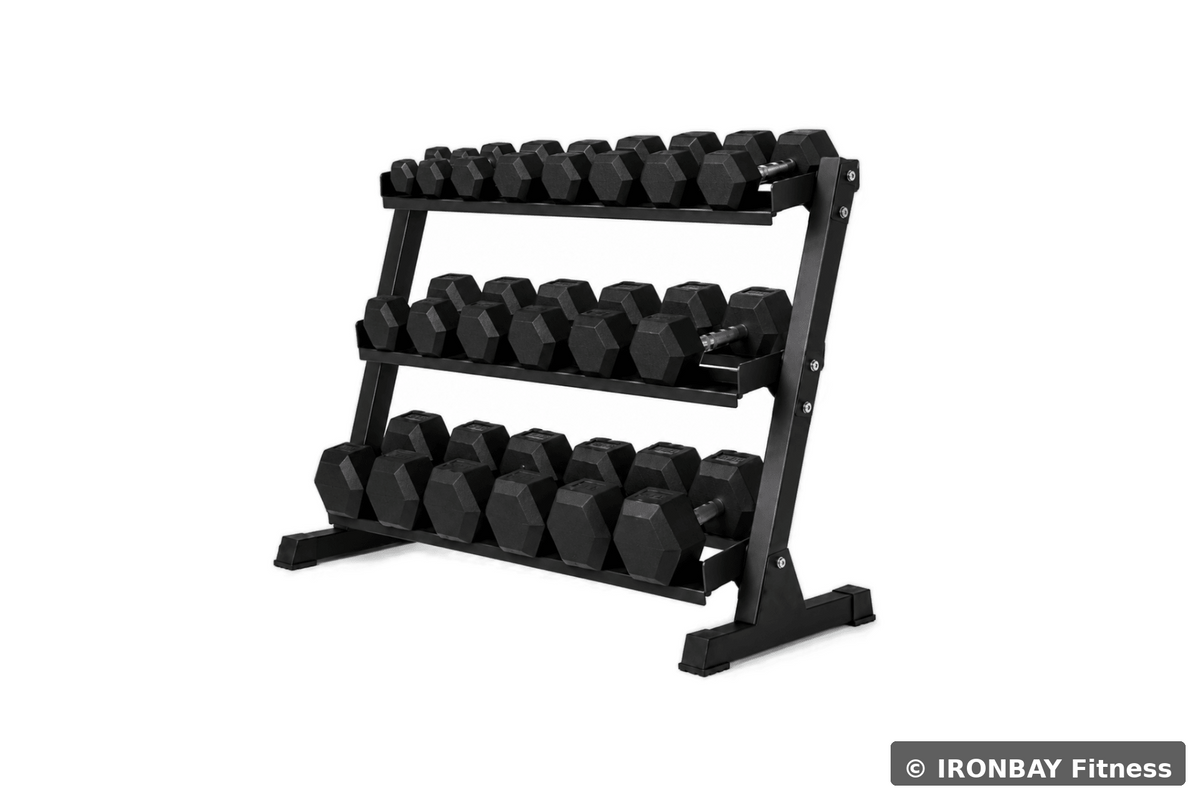
Two dumbbells of the same weight. That is the whole home gym for this workout. Hex dumbbells work best because the flat sides stop them rolling away when you set them down.
Shop IRONBAY Hex Dumbbells — $0.88/lb, from $4.40 each. Solid cast iron heads, chrome knurled steel handles, 5 to 80 lb in stock. A pair of 20 lb dumbbells is $35.20. A pair of 30 lb dumbbells is $52.80.
Want a thicker handle challenge? IRONBAY Kettlebells, $1.60/lb, from $8.00 each, 5 to 50 lb in stock. Two 25 lb kettlebells ($80.00 a pair) make a great carry weight once the 20 lb dumbbells feel light.
For a heavier carry with a bar, the IRONBAY Open Trap Bar, $160.00, lets you load plates and walk inside the frame. Same walk, more weight.
FAQ
How heavy should my farmer's carry be?
Heavy enough that the last 10 seconds of a 40-second carry feel hard, but light enough that your fingers never open and your posture stays tall. Most beginners start with a pair of 20 lb dumbbells and add 5 lb per hand when all 5 rounds feel easy.
How often should I do farmer's carries?
Two or three times a week is plenty. Grip muscles are small and tire fast. Add carries to the end of a workout or do them as a standalone 10-minute session on rest days.
Can I do farmer's carries in a small room?
Yes. Walk back and forth and count seconds instead of distance. Ten steps each way, turn slowly, keep walking until the timer ends. A hallway works too.
Does grip strength really predict how long you will live?
No, not directly. Research links weaker grip with higher health risks, but grip is a marker of overall strength, not a fortune teller. Train it because it makes every other lift better, not because of a headline.
Updated November 5, 2026. Shop online now. New to training or coming back from an injury? Check with a coach or physio before you start.


