

Ask a home gym creator which plates to buy first, and you will get an argument. This week the argument is back on Instagram. One October 27 reel tells new lifters not to buy bumper plates first, because thick bumpers eat up bar space fast. An October 22 clip lays out three plate types side by side and matches each one to a training style. Both creators are right in part, because the best plate depends on how you lift, not on which plate looks best on camera.
This guide compares the three plate types IRONBAY sells for home gyms: bumper plates, cast iron plates, and rubber grip plates. Same bar, same weights, three very different trade offs.
Key Takeaways
- Bumper plates are the cheapest per pound at $0.88/lb, and the only type made for drops. They are also the thickest, so they fill the bar fastest.
- Cast iron plates are the thinnest and the most expensive per pound at $1.20/lb. They let you load the most weight on one bar.
- Rubber grip plates sit in the middle at $1.00/lb, with built in handles that make loading and carrying much easier.
- All three types fit 2 inch Olympic bars, and all three carry a Lifetime Personal Warranty.
The Three Plates at a Glance
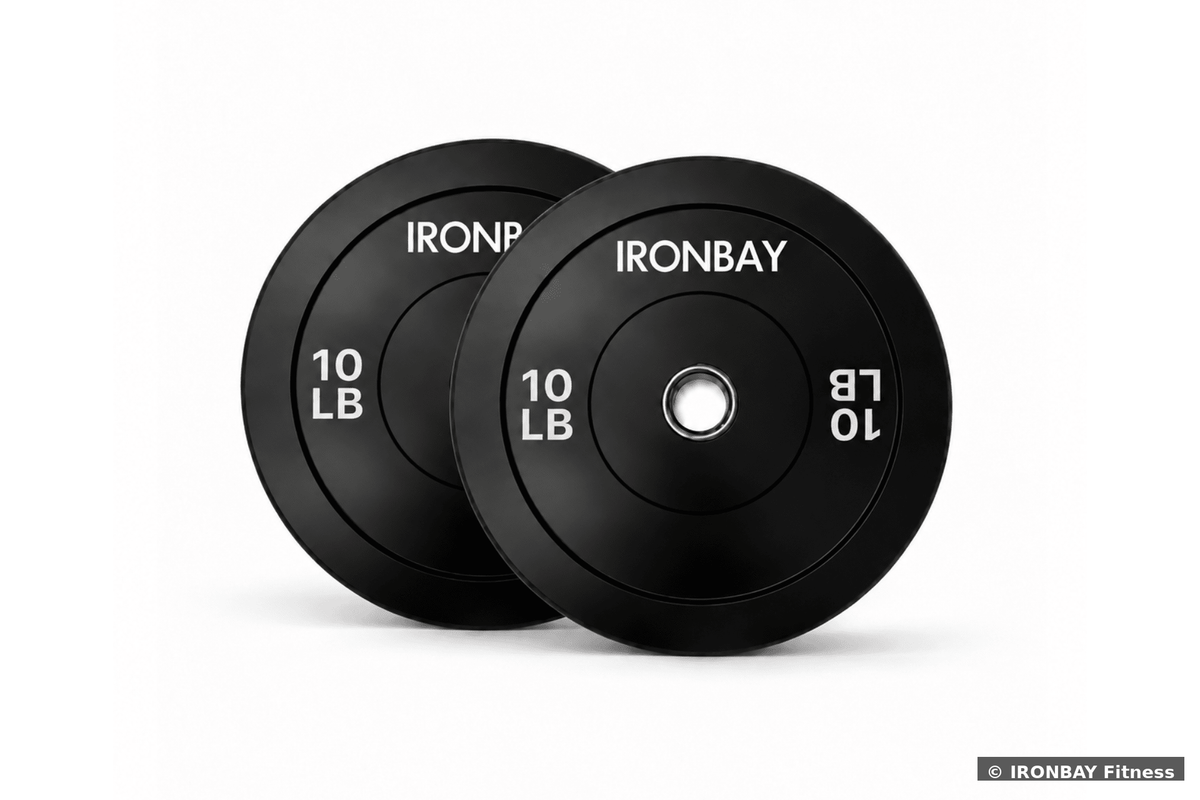
Bumper plates: Rubber plates with cast iron hub inserts, made for controlled rebound and reduced impact noise. Best for Olympic lifts and any lift you may drop. Watch for: thickness, and a mild rubber smell when new that fades after airing out.
Cast iron plates: Solid cast iron Olympic plates with a thinner profile and smaller diameter. Best for heavy squats, presses, rows, and deadlifts where you want maximum weight on the bar. Watch for: noise, and bare iron on bare floors.
Rubber grip plates: Solid steel core plates with a durable rubber coating and built in grips. Best for everyday home gym lifting, easy handling, and quieter training than bare iron. Watch for: they are thicker than cast iron, though thinner than bumpers.
Bumper Plates: Buy These If You Drop Weights
IRONBAY Bumper Plates cost $0.88/lb. Pairs run from $17.60 for 10 lb to $79.20 for 45 lb, and a 260 lb set (10 to 45 lb) is $228.80. Sizes are 10, 15, 25, 35, and 45 lb. The rubber body gives a controlled rebound, and the cast iron hub inserts keep the center hole true after repeated drops.
The trade off is space. Bumpers are all one large diameter, and the rubber makes each plate thick. That is the point of the October 27 reel: a bar loaded with bumpers runs out of sleeve room long before a bar loaded with iron does. If you never drop a bar from overhead or from hip height, you pay that space cost for a feature you do not use.
Buy bumpers if you do cleans, snatches, push presses, or CrossFit style workouts at home, or if you train on a platform and want the quietest drops. Do not drop any plate on a bare hard floor. Use mats or a platform, even with bumpers.
Cast Iron Plates: Buy These If You Want Maximum Weight on the Bar
IRONBAY Cast Iron Plates cost $1.20/lb. Pairs run from $6.00 for 2.5 lb to $108.00 for 45 lb. Sizes are 2.5, 5, 10, 25, 35, and 45 lb. The thin profile and smaller diameter leave more room on the bar and stay out of the way on curl bars, dumbbell handles, and plate loaded machines.
That thin profile is why experienced lifters keep iron around even after they buy bumpers. When the bar is already full of bumpers and you still want more weight, thin iron plates are what fit. The small 2.5 lb pair is also the cheapest way to make small jumps on presses and rows.
Buy cast iron if your training is squats, bench, presses, rows, and controlled deadlifts, and you lower every rep under control. Iron is loud, and it can mark floors, so pair it with mats. Never drop iron plates on purpose.
Rubber Grip Plates: Buy These If You Carry Plates a Lot
IRONBAY Rubber Grip Plates cost $1.00/lb. Pairs run from $10.00 for 5 lb to $90.00 for 45 lb, and a 240 lb set (5 to 45 lb) is $240.00. Sizes are 5, 10, 25, 35, and 45 lb. The rubber coating cuts noise and protects floors better than bare iron, and the built in grips make the plates easy to carry, load, and unload.
The grips are the real selling point. Anyone who has fumbled a smooth 45 lb plate onto a bar knows the difference. Grip plates also work on their own for weighted moves like plate carries and plate halos, since you have something safe to hold.

© IRONBAY Fitness. Images not for commercial use.
Buy grip plates if you train alone, load and unload the bar often, share walls with neighbours, or want one plate type that does a bit of everything. They are not drop plates like bumpers, so keep drops out of the plan.
How to Pick in 3 Questions
- Do you drop the bar? If yes, bumpers. If you always lower under control, iron or grip plates are enough.
- How much sleeve room do you have? A short bar or a heavy squat goal favours thin cast iron. Bumpers need room.
- How often do you move plates by hand? Daily loading, plate loaded machines, and small spaces favour grip plates.
The Same Starter Stack, Three Prices
Take one pair each of 45 lb, 25 lb, and 10 lb plates. That is 160 lb of plates, bar not included. The plate only totals are: bumpers $140.80 ($79.20 plus $44.00 plus $17.60), cast iron $192.00 ($108.00 plus $60.00 plus $24.00), and rubber grip plates $160.00 ($90.00 plus $50.00 plus $20.00). Bumpers win on price per pound and lose on space. Iron wins on space and loses on price. Grip plates land in the middle on both.
Pair any of the three with the IRONBAY 7 ft Olympic Bar, 20 kg ($150.00). It has a 29 mm shaft, dual needle bearings and bronze bushings for smooth sleeve rotation, and a recommended capacity of 850 lb. All three plate types fit its 2 inch sleeves. Use collars every time, even for light sets.
Safety note: check that every plate is fully on the sleeve before you lift, and keep small children and pets clear when plates are off the bar. A 45 lb plate dropped on a foot is a serious injury, grip holes or not.
FAQ
Can I mix plate types on one bar?
Yes. A common home gym mix is bumpers on the outside for drops plus thin iron plates inside for extra weight. Just keep the load balanced side to side, and never mix different weights on the two sides by mistake.
Which plate is quietest?
Bumpers, then rubber grip plates, then bare cast iron. Rubber absorbs impact and cuts clang. No plate is silent, and mats still matter, especially in an apartment or a basement with neighbours below.
What about calibrated plates?
Calibrated plates are made to exact competition weight tolerances for powerlifting meets. Most home gym lifters do not need them. The three types in this guide cover strength training, Olympic style lifting, and everyday home gym use.
Do I need a 45 lb pair first?
Not always. If you are new to barbell training, start with 10 lb and 25 lb pairs and learn the lifts with good form. Add 45 lb pairs when your squat and deadlift outgrow the lighter plates. Buying heavy first is how plates end up gathering dust.
Which plate type lasts longest?
All three carry a Lifetime Personal Warranty from IRONBAY. In daily use, iron plates are hard to wear out, rubber coatings protect against chips and rust, and bumper rubber handles drops that would crack or dent other plates. Buy for your lifting style first, not for a durability contest.
Updated November 1, 2026.
Shop online now at IRONBAY Fitness.


