

The squat is the king of leg day. But the straight bar can be rough on your shoulders, wrists, and elbows — especially if you sit at a desk all day.
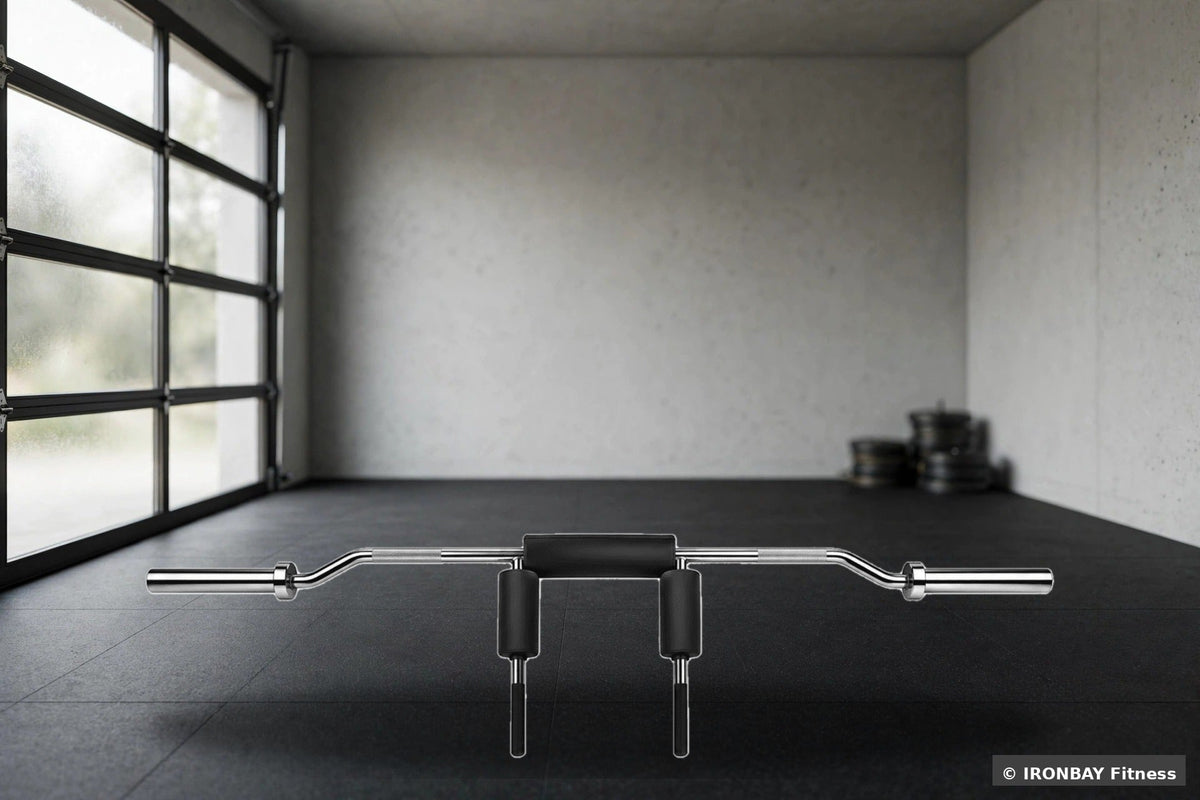
The safety squat bar fixes that. A padded yoke sits on your shoulders. Two forward handles let your hands stay in front of you. The weight sits a little forward, so you stay tall without forcing your shoulders into a painful position. Same squat. Kinder setup. Heavier legs.
This workout takes about 30 minutes. One bar. Five moves. All at home.
Key Takeaways
- The safety squat bar keeps you upright and takes pressure off your shoulders, wrists, and elbows.
- Five moves, about 30 minutes: squat, good morning, split squat, walking lunge, calf raise.
- The IRONBAY bar itself weighs 21 kg (46 lb) — count it as your starting weight.
The Workout (About 30 Minutes)
- Safety Bar Squat — 4 sets of 6 reps. Rest 90 seconds.
- Safety Bar Good Morning — 3 sets of 10 reps. Rest 60 seconds.
- Safety Bar Split Squat — 3 sets of 8 reps per leg. Rest 60 seconds.
- Safety Bar Walking Lunge — 3 sets of 10 steps per leg. Rest 60 seconds.
- Safety Bar Calf Raise — 3 sets of 15 reps. Rest 45 seconds.
Warm up 3 minutes first: leg swings, bodyweight squats, hip circles. Cool down 2 minutes: walk it out, stretch quads and hip flexors.
Form Cues
1. Safety Bar Squat. Step under the bar. Let the padded yoke sit across your shoulders. Hold the front handles with a light grip — do not pull down on them. Feet about shoulder-width apart, toes slightly out. Brace your belly like someone is about to poke it. Sit down between your hips until your thighs are about parallel to the floor. Drive the floor away and stand tall. Keep your knees tracking over your toes the whole way.
2. Safety Bar Good Morning. Same setup, feet hip-width apart. Keep your back flat and your knees soft. Hinge at the hips and push your butt back until your chest is near parallel to the floor. Feel a stretch in your hamstrings. Squeeze your glutes to stand back up. Start light — this move is humbling.
3. Safety Bar Split Squat. Take a long step back. Drop straight down until your back knee hovers just above the floor. Keep your torso tall — the bar makes this easier than a straight bar. Drive through your front foot to stand. Finish all reps on one leg, then switch.
4. Safety Bar Walking Lunge. Step forward into a long stride. Drop until both knees are near 90 degrees. Do not let your front knee cave inward. Push through your front foot and step through to the next rep. Short on space? March in place and alternate legs.
5. Safety Bar Calf Raise. Stand with the balls of your feet on the edge of a weight plate, heels hanging off. Rise up tall on your toes. Pause one second at the top. Lower slowly until your heels drop below the plate edge. Slow down beats heavy weight here.

© IRONBAY Fitness. Images not for commercial use.
What Weight Should You Start With?
Start with the empty bar. It weighs 21 kg (46 lb), so your first squat is already a real set. When 4 sets of 6 feel smooth, add plates in small jumps. The bar holds up to 700 lb, so it grows with you for years.
Specs that matter: 2200 mm overall length, 30 mm handles, chrome-plated steel, padded shoulder support, dual forward handles.
Shop the IRONBAY Safety Squat Bar — $200. Pair it with IRONBAY Bumper Plates to load up. Shop online now. IRONBAY Fitness opens Nov 1, 2026.
FAQ
What is a safety squat bar?
A squat bar with a padded yoke that rests on your shoulders and two handles that point forward. You hold the handles in front of you instead of reaching back to grip a straight bar. It shifts the weight slightly forward, which helps you stay upright.
Does a safety squat bar help with bad shoulders?
For many lifters, yes. You never have to crank your shoulders back to hold the bar. Your hands stay in front in a neutral position. If you have a shoulder or wrist issue, check with a coach or physio before you load up.
Can beginners use a safety squat bar?
Yes. It is one of the friendliest ways to learn the squat. The yoke stays put, the handles give you something to hold, and the upright posture is easier to find. Start with the empty bar and own the pattern first.
Do I need a squat rack for this workout?
Use the bar inside a squat rack with safety arms set just below your lowest squat depth. That way a failed rep is a non-event: set the bar down on the safeties and step out.
Updated October 13, 2026. New to training or coming back from an injury? Check with a coach or physio before you start.


