

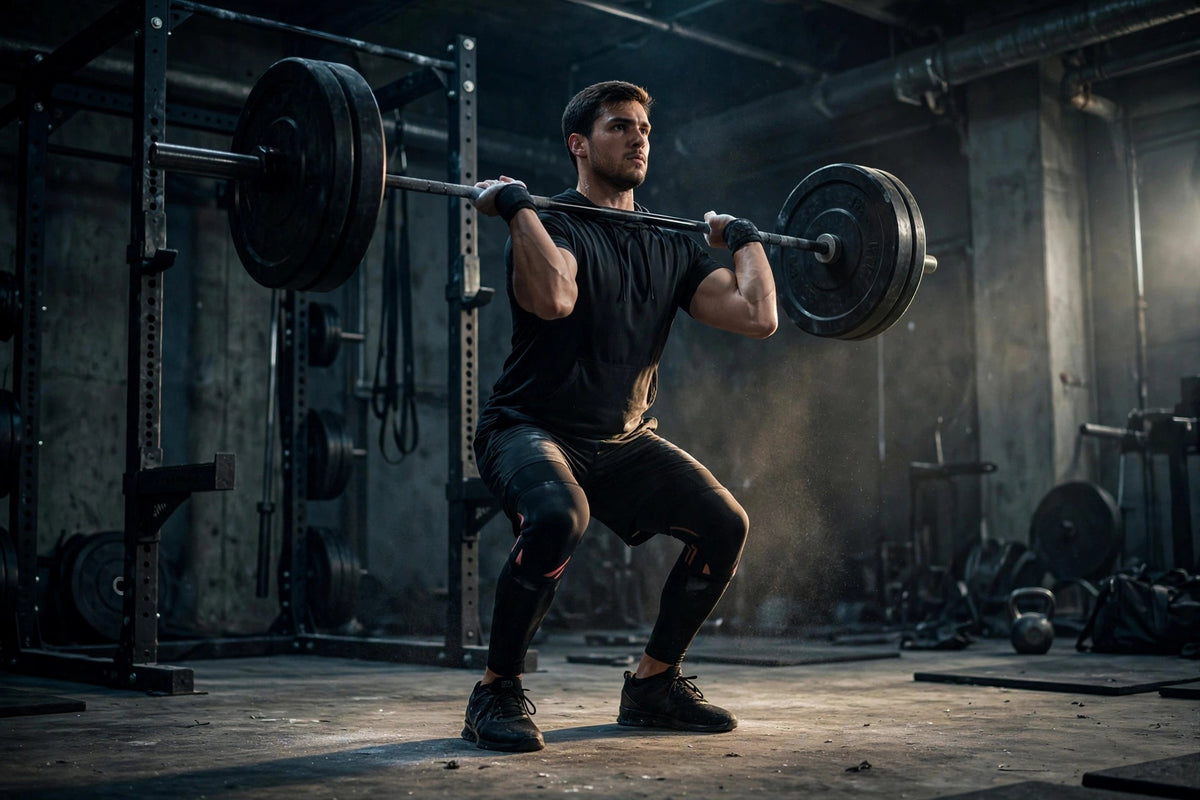
"One barbell" is one of the hottest workout formats on fitness social right now. Creators everywhere are posting full-body sessions built on a single bar — no rack, no machine, no swapping equipment. The barbell complex is the king of that format: six moves, one bar, and you don't set it down until the round is over.
This article turns that trend into a real plan for your home gym. Six compound moves, six reps each, back to back. Your legs, back, shoulders, and core all get hit — and your lungs will know about it too.

© IRONBAY Fitness. Images not for commercial use.
Key Takeaways
- A barbell complex = 6 moves, 6 reps each, no setting the bar down. Rest 2 minutes, repeat 3–5 rounds.
- The weight that feels light for squats will feel heavy by the push press — start with an empty bar.
- One round takes about 5 minutes. Three rounds is a complete 25-minute full-body home workout.
The Workout (6 Moves, One Bar)
Do all six moves back to back without setting the bar down. That is the rule that makes it a complex — and the reason it works.
- Move 1 — Romanian deadlift: 6 reps. Hinge, don't squat.
- Move 2 — Bent-over row: 6 reps. Pull to your lower ribs.
- Move 3 — Hang clean: 6 reps. Jump, shrug, catch.
- Move 4 — Front squat: 6 reps. Elbows high, chest up.
- Move 5 — Push press: 6 reps. Dip, drive, lock out.
- Move 6 — Back squat: 6 reps. Bar on your upper back, sit deep.
Rest 2 minutes. That is one round. Do 3 rounds to start; work up to 5.
October challenge option: run this complex 3 times a week through October. Add one round — or a small plate per side — each week. By Halloween you will be doing 5 rounds with weight you once thought was a warm-up.
EMOM option: start a new round every 5 minutes on the clock. When you finish early, the leftover time is your rest. It keeps you honest.
The 6 Moves
Move 1 — Romanian deadlift.

Stand tall with the bar at your hips. Push your hips back and slide the bar down your thighs to mid-shin. Keep your back flat and your knees soft. Drive your hips forward to stand. This is a hinge — your knees bend a little, but the movement lives in the hips.
Move 2 — Bent-over row.

Hinge forward until your torso is close to parallel with the floor, back flat. Let the bar hang below your chest, then pull it to your lower ribs, squeezing your shoulder blades together. Lower with control. Your lower back does not move — this is a back move, not a bounce.
Move 3 — Hang clean.

Start standing with the bar at your upper thighs. Dip slightly, then explode upward — jump and shrug at the same time. As the bar rises, drop under it and catch it on the front of your shoulders with your elbows high and forward. Stand up. If the clean is new to you, practice the catch with an empty bar first: the bar lands on your shoulders, never on your throat.
Move 4 — Front squat.

The bar is already on your shoulders from the clean. Keep your elbows high so the bar sits on the shelf of your front delts, not in your hands. Sit down between your heels, chest up, knees tracking over your toes. Drive up through your whole foot. Elbows drop, bar rolls — so keep them up.
Move 5 — Push press.

From the front-rack position, dip your knees a few inches, then drive up hard and press the bar overhead in one motion. Lock your arms with the bar directly over your shoulders — not in front of your face. Lower it back to your shoulders with control. Your legs do half the work here; let them.
Move 6 — Back squat.

Carefully move the bar behind your head and rest it on your upper back — on the thick muscle across your shoulders, below your neck, never on the neck itself. Hands grip wide to lock it in place. Sit back and down with your chest up, then drive up. Six reps, and the round is done. Set the bar down.
Safety: warm up 3 minutes first — bodyweight squats and arm circles work fine. Always use collars so plates can't slide. Learn the clean with an empty bar before adding weight — it is the most technical move here. Clear about 2 by 2 metres of floor, train on mats, and lower the bar with control instead of dropping it.
What Bar Should You Start With?
A good general starting point: run your first sessions with the empty bar only. A 20 kg bar with no plates still builds real strength when you don't rest between moves — that is the whole point of a complex. Add small plates only when you can finish 3 rounds with clean form.
Most home lifters land on a standard 20 kg Olympic bar: 29 mm shaft, medium knurling, and dual needle bearings so the sleeves spin smooth on cleans. A 15 kg bar with a slimmer 28 mm shaft is the easier starting point if the 20 feels like too much bar to learn the clean with.
What You Need
One barbell. That is the entire gym for this workout — no rack, no bench, no dumbbells. Every move starts from the floor or the hang, so you never need to unrack.
The IRONBAY 7 ft Olympic Bar (20 kg) is built for exactly this kind of work: chrome-plated steel, 29 mm shaft with medium 1.3 mm knurling, dual needle bearings plus bronze bushings for smooth sleeve spin on cleans, rated to 850 lb, and backed by a 3-year warranty.
Shop the IRONBAY 7 ft Olympic Bar (20 kg) — $150.00.
Learning the clean and want a lighter bar to start? The 15 kg version runs the same 7 ft length with a 28 mm shaft and bronze bushings, rated to 550 lb with a 1-year warranty. Shop the 15 kg bar — $80.00.
Shop online now. IRONBAY Fitness opens Nov 1, 2026. Calgary pickup available.
FAQ
Can you build muscle with just a barbell at home?
Yes — for beginners and intermediates, a complex like this delivers progressive overload across every major muscle group. When 5 rounds get easy, add weight to the bar instead of adding rounds.
Do I need a squat rack for this workout?
No. That is the beauty of a complex: every move starts from the floor or the hang position. You never unrack, so you never need a rack.
How heavy should the bar be for a complex?
Lighter than you think. Pick a weight you could strict-press for 6 clean reps — the push press is always the limiting move. Most people start with the empty bar and add plates over weeks.
How often should I do this workout?
Two to three times a week with a rest day between sessions. Complexes are demanding on the whole body; more is not better.
Will a barbell damage my floor?
Train on rubber mats and lower the bar with control instead of dropping it. An empty or lightly loaded bar is quiet — the noise comes from dropping, not lifting.
Updated October 2, 2026. New to training or coming back from an injury? Check with a coach or physio before you start.


