

Kettlebell Buying Guide: How to Pick the Right Weight the First Time
One question stops more first time kettlebell buyers than any other: what weight should I buy? Buy too light and you outgrow it in weeks. Buy too heavy and your form falls apart. This guide gives you a simple test to pick right the first time, plus what to look for in the bell itself.
Shop online now. IRONBAY Fitness opens Nov 1, 2026.
Key Takeaways
- Use the 10 rep test: pick a bell you can swing with crisp form for 10 reps, and still have good reps left in the tank.
- Buy for presses, not just swings. Your hips will outgrow your shoulders, so plan for two bells, not one.
- For most people starting out, a swing bell plus one step lighter for presses covers the first year of training.
- Cast iron is the best home gym choice: simple, durable, and it never wears out.
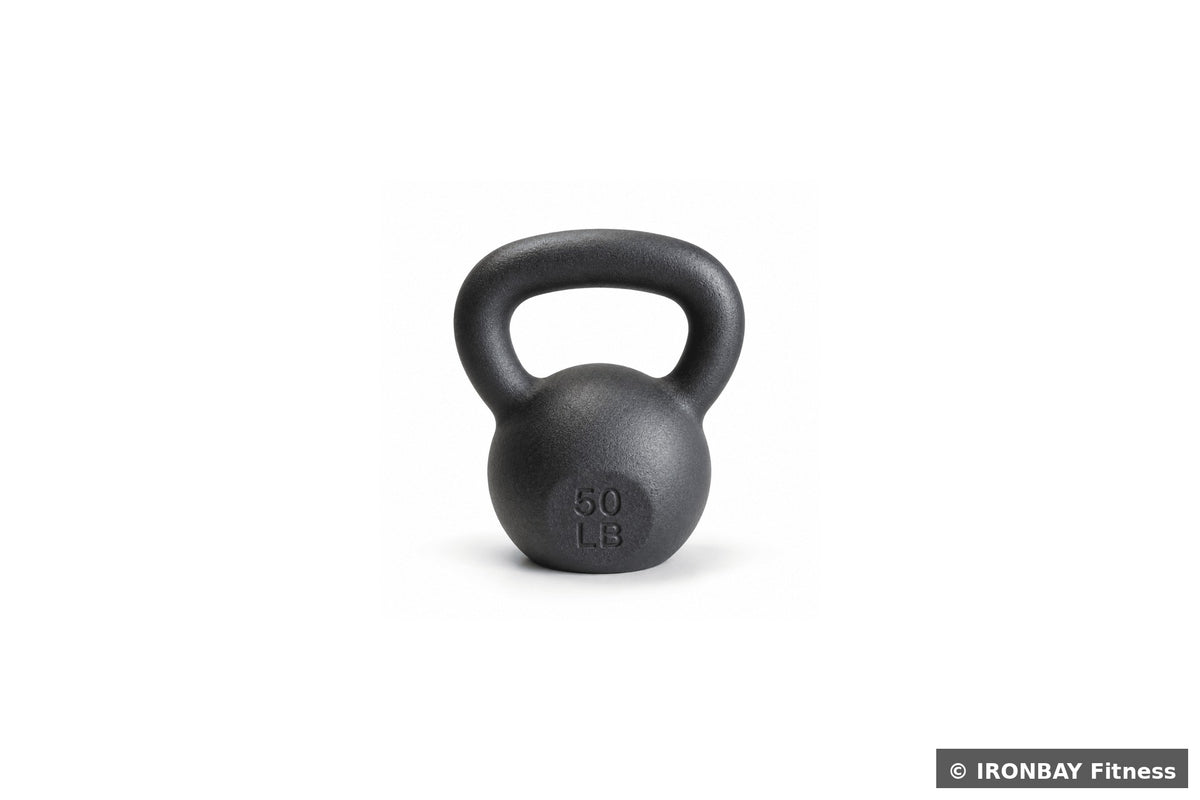
- IRONBAY cast iron kettlebells run $1.60 per lb, from $8.00 for a 5 lb bell to $80.00 for a 50 lb bell.
The 10 Rep Test: Your Weight Picker
Forget charts that hand you one magic number. Your body gives you the answer in one set. Stand tall, hinge at the hips, and swing the bell with two hands. Ask three questions:
- Can you do 10 crisp swings, with the bell floating to about chest height each time?
- Does your back stay flat and your core stay braced on every rep?
- Could you do 10 more reps with the same form if you had to?
If all three answers are yes, that weight is your swing bell. If the bell pulls you forward, or your form breaks down before rep 10, go one step lighter. If 10 reps feel easy and boring, go one step heavier. This test works because a kettlebell swing is a hip power move. The bell should feel heavy enough to make your hips work, but light enough that your hips, not your arms, do the work.
As a general starting reference, people new to strength training often land around a 25 lb swing bell, while people who already lift dumbbells or barbells often land around a 35 lb swing bell. These are starting points, not rules. The test above is what decides.
Swings vs Presses: Why You Need Two Weights
Here is the mistake most buyers make. They pick one bell for swings, then try to press it overhead with one arm. Swings use your hips, the strongest muscles in the chain. Presses use your shoulders, a much smaller group. One bell cannot serve both jobs well.
The fix is simple. Your second bell should be one step lighter than your swing bell. Swing 35 lb, press 25 lb. Swing 25 lb, press 15 lb. That lighter bell also covers goblet squats, single arm rows, Turkish get ups, and carries while you build strength. When your press catches up, your old swing bell becomes your press bell, and you buy a heavier swing bell. That is how a small set grows with you, one bell at a time.
Cast Iron vs Competition vs Adjustable
Three types of bells fill the market. For a home gym, the choice is clear.
- Cast iron: One solid piece of iron. The bell gets physically bigger as the weight goes up. Wide handle, great for two hand swings. Cheapest per lb, lasts forever, and the best used buy in all of fitness because it never wears out. This is what IRONBAY sells, and what most home gyms should buy.
- Competition: Every weight is the same size, color coded, with a tighter handle. Built for kettlebell sport, where the same technique must work at every weight. Great if you compete. Overkill and pricier for general home training.
- Adjustable: One bell that changes weight. Good if floor space is very tight or you are still unsure of your weights. But the mechanism adds cost and moving parts, and most lifters end up buying fixed bells anyway for fast, heavy swings.
IRONBAY bells are old school solid cast iron with a rust resistant finish. No vinyl, no rubber coating, nothing to peel or crack. They carry a Lifetime Personal Warranty.
IRONBAY Kettlebell Sizes and Prices
IRONBAY lists cast iron kettlebells from 5 lb to 80 lb. Right now the 5 lb to 50 lb bells are the ones in stock, all at $1.60 per lb:
| Weight | Price | Good for |
|---|---|---|
| 5 lb | $8.00 | Learning the hinge, warm ups |
| 10 lb | $16.00 | First presses and get ups |
| 15 lb | $24.00 | Press bell for new lifters |
| 20 lb | $32.00 | Press bell, goblet squats |
| 25 lb | $40.00 | Common first swing bell |
| 30 lb | $48.00 | Swing bell step up |
| 35 lb | $56.00 | Common swing bell for lifters |
| 40 lb | $64.00 | Heavier swings, carries |
| 45 lb | $72.00 | Strong swing bell |
| 50 lb | $80.00 | Heavy swings and deadlifts |

© IRONBAY Fitness. Images not for commercial use.
Your First Week With Your New Bell
Three sessions, 20 minutes each, with one rest day between sessions. Each session: 5 sets of 10 two hand swings, 3 sets of 5 goblet squats, and 3 sets of 5 single arm presses per side with your lighter bell. Rest 60 seconds between sets. That is 50 swings, 15 squats, and 30 presses per session. If your form stays clean through all three sessions, you picked right. If the last sets get sloppy, drop one step lighter and rebuild. Strength built on clean reps lasts. Strength built on sloppy reps just builds bad habits.
FAQ
Is one kettlebell enough to start?
Yes. One bell that passes the 10 rep test covers swings, squats, presses, rows, get ups, and carries, a full body session. Plan to add a second, lighter bell within a few months, because your hips will outgrow your shoulders.
What if I buy too light?
A bell that is too light for swings will not train hip power, and you will outgrow it fast. But a light bell is never wasted. It becomes your press bell, your warm up bell, and your technique bell. Start light, add heavy. Never the other way around.
What if I buy too heavy?
Too heavy ruins form first and risks your back second. If you cannot pass the 10 rep test with clean form, the bell is too heavy for now. Go lighter, build the pattern, and come back to the heavier bell in a few months.
Cast iron or competition bells for a home gym?
Cast iron. It is cheaper, tougher, and the wider handle suits two hand swings. Competition bells make sense if you train kettlebell sport. For general home training, cast iron wins.
Do I need chalk?
Not to start. A clean, dry handle and dry hands are enough for most home sessions. If your hands sweat a lot during long swing sets, chalk helps your grip and protects your skin.
How much floor space does a kettlebell need?
Almost none. One bell parks in a corner. A swing needs about one step of clear space in front of you and behind you. That is why the kettlebell is the smallest full gym you can own.
Updated October 27, 2026.


