

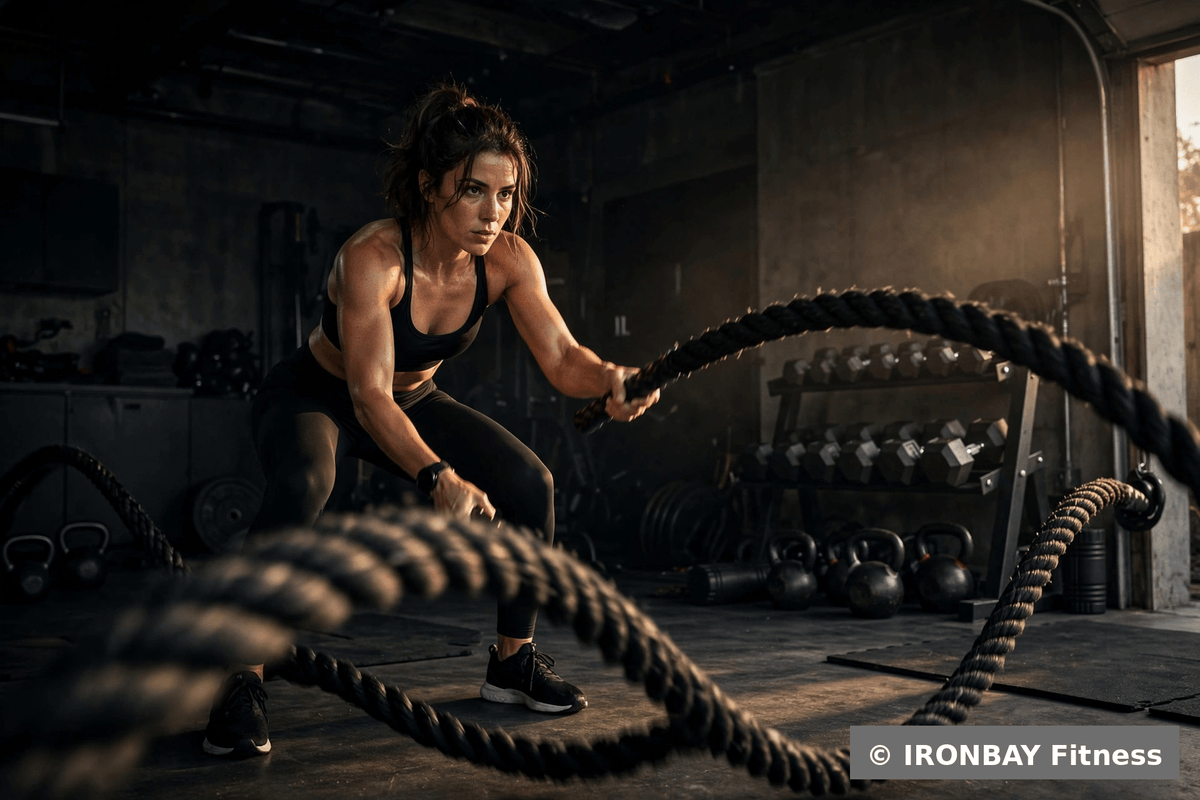
You don't need a treadmill. You need one rope, two square metres of floor, and fifteen minutes.
The battle rope is the most honest conditioning tool in a home gym. It doesn't lie. If your grip gives out at minute eight, that's the workout telling you exactly where you stand. Alternating waves, slams and pulls train your shoulders, back, grip, core and lungs in a single tool. One rope. No motor, no membership.
Key Takeaways
- 15 minutes total: 5 rounds of a 3-minute EMOM — alternating waves, rope slams, pull-through drags.
- Work 40 seconds, rest 20 seconds each minute. When your grip fails first, that is the point: grip is the limiter in rope conditioning.
- One IRONBAY Battle Rope ($150) anchors to a rack post or any heavy fixed point. HYROX-style conditioning, at home.
The Workout (15 Minutes)
- Warm up 2 minutes: arm circles, hip hinges, 20 bodyweight squats.
- Minute 1: Alternating waves — 40 seconds on, 20 seconds off.
- Minute 2: Rope slams — 40 seconds on, 20 seconds off.
- Minute 3: Pull-through drags — 40 seconds on, 20 seconds off.
- Repeat steps 2–4 for 5 rounds (15 minutes total).
- Cool down 2 minutes: walk it out, shake out your arms, stretch forearms and shoulders.
Form in 6 Steps
Step 1 — Set your stance.

© IRONBAY Fitness. Images not for commercial use.
Feet shoulder-width apart, knees soft, hips pushed back slightly, chest up, core tight. Anchor the rope in front of you — a rack post or anything heavy that won't move.
Step 2 — Take your grip.

© IRONBAY Fitness. Images not for commercial use.
One handle in each hand, palms down, thumbs wrapped. Elbows stay soft, arms almost straight in front of your shoulders.
Step 3 — Alternating waves.

© IRONBAY Fitness. Images not for commercial use.
Left arm up, right arm down, then switch. Pump like pistons — fast, small moves make the best waves. Each wave should travel all the way to the anchor.
Step 4 — Bilateral waves.

© IRONBAY Fitness. Images not for commercial use.
Both arms together, big and fast. Drive from the shoulders and use a small knee bounce to keep the rhythm. Chest stays up — don't hunch.
Step 5 — Rope slam.

© IRONBAY Fitness. Images not for commercial use.
Both arms overhead, then drive the rope down as hard as you can, hinging at the hips. Follow through — arms finish low, past your hips.
Step 6 — Pull-through drag.

© IRONBAY Fitness. Images not for commercial use.
Face the anchor, lean back, and pull the rope hand over hand toward your chest. Legs braced, back flat — this is a row, not a curl.
What You Need
One battle rope. That's the entire conditioning room.
Shop IRONBAY Battle Rope — $150. Thick twisted rope with rubber-dipped handles for waves, slams and pulls. 3-year warranty. Shop online now. IRONBAY Fitness opens Nov 1, 2026.
FAQ
Can battle ropes build muscle?
They build conditioning, grip and shoulder endurance more than size. Add rope days to a strength program if you want both.
How much space do I need for a battle rope at home?
About 3 metres from the anchor to where you stand, plus room to move your arms. A garage, driveway or backyard works great. A second-floor apartment at 6 a.m. does not — slams are loud.
Why do my arms give out before my lungs?
That is normal. Rope work is grip-limited for almost everyone at first. Shorten the work to 20–30 seconds while your grip catches up.
Is a battle rope good for beginners?
Yes. Start with 20 seconds on, 40 seconds off, and stop the set when your form breaks. The rope scales to any level.
Updated October 6, 2026. New to training or coming back from an injury? Check with a coach or physio before you start.
© IRONBAY Fitness. Images not for commercial use.


